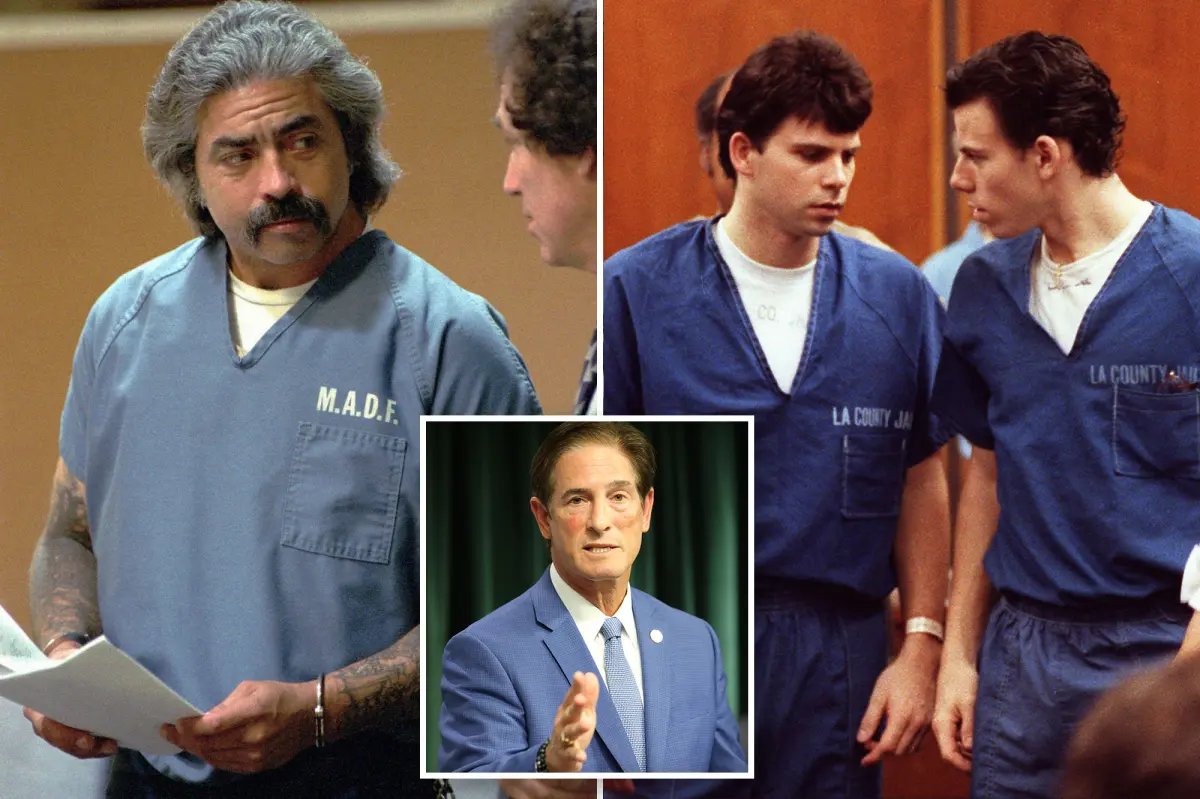


Los Angeles County District Attorney Nathan Hochman is warning that Gov. Gavin Newsom’s sweeping decision to spare 548 California death row inmates could eventually allow convicted killers to seek freedom, including more than 100 sentenced in Los Angeles County.
In an exclusive interview with the California Post, Hochman pointed to the notorious Menendez brothers, whose high-profile resentencing battle was among the first major cases he inherited after taking office in December 2024, as evidence that life without parole does not always guarantee someone will die behind bars.
“The Menendez case is exhibit A to show that that statement is just simply not accurate,” Hochman told The Post, challenging Newsom’s assurance that the condemned prisoners would spend the rest of their lives in prison.
Erik and Lyle Menendez faced the death penalty for the 1989 shotgun murders of their parents in Beverly Hills but were ultimately sentenced to life without parole in 1996. Nearly three decades later, a judge reduced their sentences to 50 years to life under California’s resentencing laws, making them eligible for parole because they were under 26 at the time of the killings.
Hochman opposed their resentencing after inheriting the case from his predecessor, George Gascón, who had supported reducing their sentences.
Now Hochman argues the same uncertainty could eventually confront families of victims whose killers are being spared execution.
“When Newsom goes ahead and says, as he did in his announcement, that these individuals, even though they’re no longer on death row, will spend the rest of their natural lives behind bars, he can’t say that with any degree of certitude,” Hochman warned.
Newsom announced Thursday that he would commute California’s 548 death sentences to life imprisonment without the possibility of parole, extending his yearslong opposition to capital punishment.
The governor, who imposed a moratorium on executions in 2019, defended the decision on moral grounds, arguing that the death penalty cannot be administered fairly in an imperfect justice system.
“I know we cannot execute people in our imperfect legal system and remain true to our core values, first among them justice and human decency,” Newsom wrote in an open letter.
“These offenders will die in prison but not by our hand,” he added.
But Hochman questioned the timing and the sweeping nature of the decision.
“It felt like he woke up one day, seven years into his term, on the eve of leaving, and decided that he had the moral imperative to commute all these sentences,” Hochman said.
He said that more than 100 Los Angeles County cases would be affected by the decision.
Hochman also said the governor of failed to consult victims’ families before announcing the commutations, leaving relatives who had endured years of trials, appeals and sentencing proceedings facing renewed uncertainty.
“It sort of has the tragedy replayed once again for them,” Hochman said.
Some victims’ families echoed those concerns.
“It’s total disrespect for the victims. It’s a slap in the face,” Sandy Friend, whose 8-year-old son Michael Lyons was abducted, raped and murdered in 1996, told the Los Angeles Times.
Phyllis Loya, whose son Larry Lasater was a Pittsburg police officer killed in the line of duty, also criticized the governor.
“He doesn’t care about us,” Loya told the Los Angeles Times, accusing Newsom of showing greater concern for convicted killers than their victims.
The governor’s decision also faces a legal hurdle. The California Supreme Court must approve commutations for inmates with multiple felony convictions.
California has not executed a prisoner since 2006, and Newsom’s action does not repeal the death penalty.
Hochman confirmed that his office will continue reviewing death-penalty-eligible cases, although none of the more than 50 cases evaluated since he took office has met his standards for pursuing capital punishment.
He also acknowledged that his office cannot reverse Newsom’s constitutional clemency decisions but vowed to intervene if any affected inmates eventually seek release.
“If these cases come back into court, in other words, if they’re able to somehow seek parole at some point in the future, our office will get very involved with that,” Hochman said.
The LAPD declined to comment.
