
Russia was placed on emergency lockdown overnight after coming under siege from an unprecedented aerial onslaught, with the Kremlin claiming to have downed a staggering 1,214 Ukrainian drones stretching from Moscow all the way to the Urals. The massive cross-border offensive marks the single largest drone interception tally of the war, eclipsing the previous reported record of 1,110 set only last month. Moscow became a prime battleground as air raid sirens wailed and air defence batteries scrambled to repel waves of attacks. Mayor Sergei Sobyanin claimed an astonishing 613 unmanned aircraft were directed at the capital and the surrounding region alone, alleging 231 were intercepted on approach while the rest were neutralised at a distance.
Russia’s aviation watchdog, Rosaviatsiya, immediately clamped down on the skies, imposing emergency restrictions across major transport hubs, including Vnukovo, Domodedovo, and Zhukovsky. Hundreds of passenger flights were grounded or diverted – with two planes from Istanbul forced into mid-air U-turns before reaching Vnukovo.
Terrified residents in Moscow Oblast reported hearing a barrage of deafening explosions near Naro-Fominsk, located just 30 miles southwest of the capital. The Kremlin admitted its anti-air units were forced into frantic action across 19 separate Russian regions as swarms penetrated deep into Vladimir Putin’s heartland.
In the republic of Bashkortostan, over 800 miles east of the border, a devastating strike ignited the Bashkir Soda Company industrial complex in Sterlitamak – a key hub manufacturing vital components for military body armour, combat helmets, and armoured aviation protection. Further waves were intercepted over Bryansk, Belgorod, Kursk, Tula, Kaluga, Voronezh, Rostov, Samara, Saratov, and Udmurtia, while unconfirmed reports pointed to a targeted strike on the Marinovka military airfield in the Volgograd region.
Ukraine also bagged a rare and sensational air-defence victory, with footage revealing a US-supplied MIM-23 Hawk surface-to-air missile blowing two incoming Russian 3M14 Kalibr cruise missiles – jointly worth £3million – out of the sky in a single strike. The blast detonated the lead missile, instantly triggering a chain reaction that destroyed the trailing second weapon.
Ukraine’s relentless cross-border blitz aims to dismantle Putin’s war machine from within, specifically hammering oil refineries, weapons plants and airbases to bleed Moscow’s economy, choke off frontline supply lines and destroy the Kremlin’s illusion that everyday Russian life remains untouched.
In retaliation, Russia has unleashed devastating combined barrages of cruise missiles, ballistic weapons, and Shahed swarms to plunge Ukraine into darkness – systematically pounding energy grids, water supplies and civilian apartment blocks across major cities like Kyiv and Kharkiv to freeze the nation as winter approaches and break its resolve.
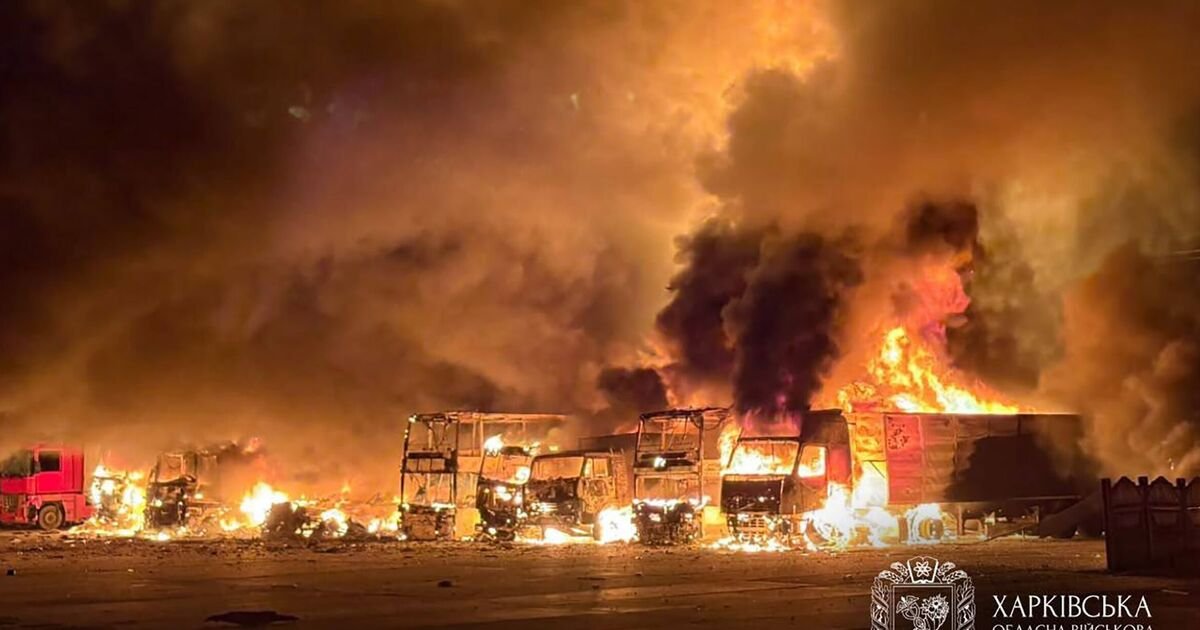
Overnight, Russian killer drones struck an educational institution in Kharkiv, setting the second city ablaze, while a civilian industrial facility was hammered in the Sarny district of Rivne, killing a man and sparking intense fires. The spiralling attacks have cast fresh doubt over US-led efforts to engineer peace talks between Moscow and Kyiv.
Putin’s foreign policy aide, Yuri Ushakov, issued a stern warning that the timing of any three-way summit involving Russia, Ukraine and the US would hinge strictly on battlefield gains, while pointing the finger at Kyiv for derailing previous rounds of diplomacy.
Grieving families have lashed out at military chiefs following the death of machine gunner Alisher Svirin – believed to be the first soldier born in 2008 killed in the conflict after being deployed days after coming of age – sparking outrage that brainwashed young recruits and school-leavers are being used as cannon fodder to replenish Putin’s battered forces.
