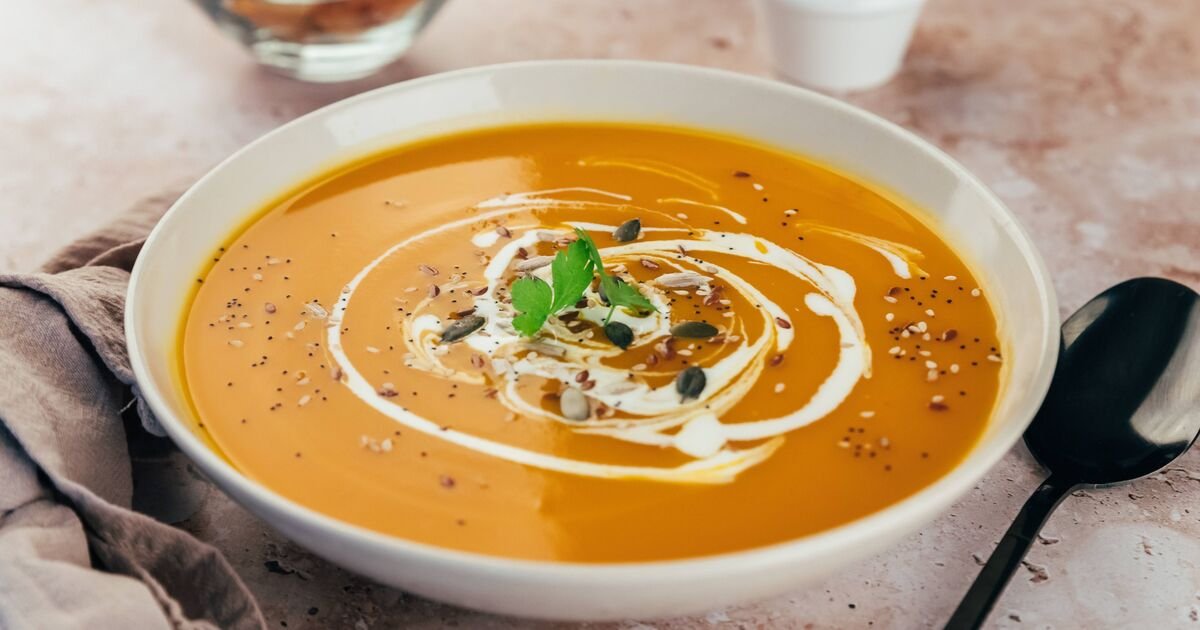


There are endless varieties of soup adding plenty of veg to your diet (Image: Cris Cantón via Getty Images)
A proper bowl of soup means something different to everybody, yet most would agree that the finest varieties are thick and velvety, best enjoyed alongside a chunk of crusty bread. Whether your preferred recipe is autumnal squash or cream of tomato, achieving that smooth, spoon-coating consistency seems to demand a generous glug of dairy.
However, that needn’t be the case. Gloriously silky soups that feel truly indulgent can be crafted without reaching for the cream, relying instead on a modest cupboard staple. Food and nutrition expert Sara Haas, speaking to The Spruce Eats, reveals that her classical French culinary training taught her that texture is all about technique, not dairy.

People tend to add cream to help thicken their soup (Image: Getty)
“The funny thing about creamy soups is that many of the good ones don’t have much cream in them at all”, she said.
Frequently, a small splash of cream is stirred in at the end simply to round out the flavours, contributing very little to the overall consistency. Sara explains that she favours an alternative “trick” involving a tin of beans.
“It’s simple,” she told The Spruce Eats. Ladle out some hot broth, blitz it in a blender with drained, rinsed cannellini or other white beans until completely smooth, then pour the purée back into the simmering pot and allow everything to combine.
As she describes it, the result “looks creamy” and “tastes creamy,” yet contains no cream, no flour, no cornstarch whatsoever.
Substituting heavy cream for blended white beans transforms soup into something luxuriously smooth while considerably boosting its nutritional value — a swap wholeheartedly endorsed by food experts for both its texture and health benefits.
Unlike cream, which delivers little beyond saturated fat and calories, a full tin of puréed beans provides roughly 350 kcal, while delivering a substantial amount of dietary fibre (up to 20 grams) and plant-based protein (15-20 grams), alongside essential micronutrients such as iron and folate.
For a similar calorie count (approximately 350 kcal), heavy cream offers virtually none of these nutritional advantages, being made up primarily of saturated fat.
Cream should only be incorporated to finish a soup, as depending on it for substance can water down the flavour of your stock and, according to culinary professionals, is liable to split or curdle when reheated.
When blended until ultra-smooth with hot liquid, beans produce a silky texture that replicates dairy without the heaviness, enabling vegetables, herbs, and quality stock to take centre stage.

White beans need to blend to help thicken a soup (Image: Getty)
Sara also advocates vegetable purées as subtle thickening agents. Cauliflower – steamed or roasted – is particularly effective because, as she observes, it has a “neutral flavour like beans,” so it disappears into the background while contributing body.
Stir a cup of blitzed cauliflower into a pan of mushroom, broccoli, or parsnip soup, and you’ll notice immediate creaminess, with your aromatics and stock taking the lead.
Built-in thickening is another cream alternative. “Another idea is to puree part of your soup and add it back to the pot,” said Sara, a technique that works brilliantly with starchy veg like potatoes and winter squash.
Scoop out a serving of your simmered soup – whether it’s sweet potato bisque or roasted butternut – blitz it until velvety-smooth, then pour it back into the pot.
