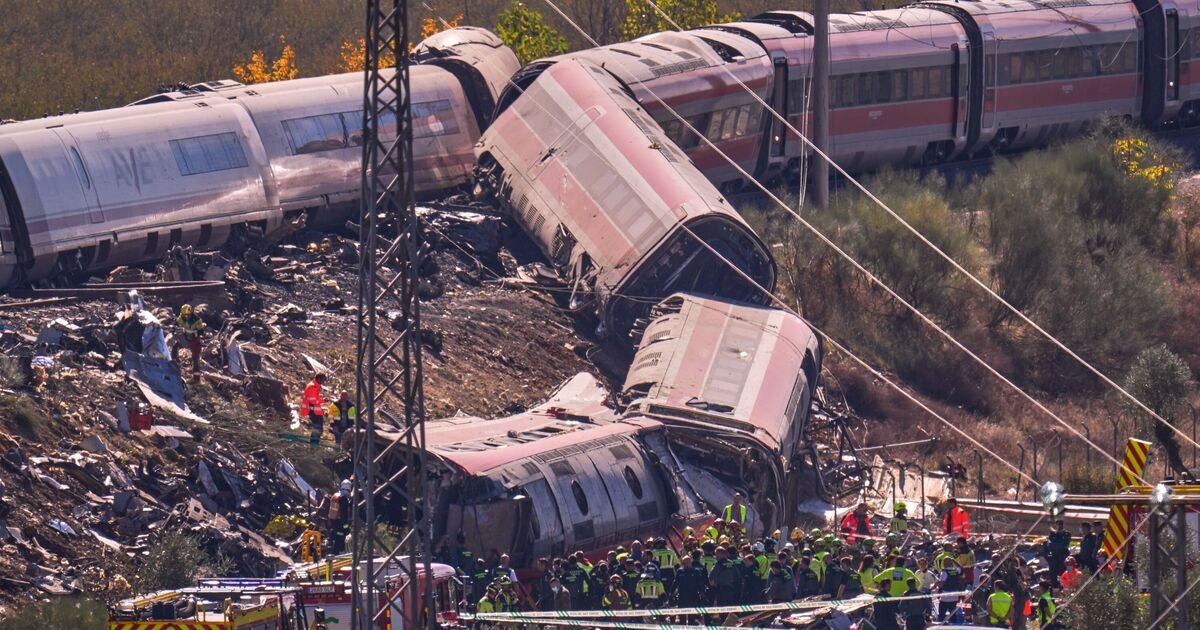


Emergency services at the scene of today’s deadly train collision in Urda, Spain (Image: AP Photo/Manu Fernandez)
Spain has been rocked by three major train disasters in 2026, with dozens of people killed and hundreds more injured. The latest tragedy struck on Wednesday morning, when two high-speed trains collided in the province of Toledo, leaving at least 64 people dead. The collision comes just nine months after two deadly rail disasters struck Spain within the space of just two days.
The first, near the town of Adamuz in southern Spain, became the country’s worst rail disaster in more than a decade, with 46 people ultimately losing their lives.
Just two days later, another train derailed near Barcelona after a retaining wall collapsed onto the tracks, killing the driver and injuring dozens of passengers. Together, the three incidents have claimed at least 110 lives and left hundreds of people injured.
Wednesday’s disaster has once again put Spain’s railways in the spotlight as emergency crews continue to work at the scene in Toledo. Here is a look at the three deadly train tragedies to have struck Spain in 2026.

The map shows the locations of the three fatal train crashes to have struck Spain in 2026 (Image: Reach plc)
Adamuz train disaster – January 18: ‘We had to remove the dead to get to the living’
Spain was plunged into mourning on January 18 when two high-speed trains collided near Adamuz, in the southern province of Córdoba, on the same Madrid-Andalusia high-speed line where today’s tragedy occurred.
An Iryo train carrying around 300 passengers was travelling from Málaga to Madrid when its rear carriages derailed and crossed onto the opposite track, where they collided with a Renfe train travelling from Madrid to Huelva.
The death toll eventually rose to 46, while more than 150 people were injured in what became Spain’s deadliest rail disaster in more than a decade.
The scale of the destruction prompted local residents to rush to the aid of passengers before and alongside emergency services.
Córdoba’s firefighting chief Francisco Carmona described the horrific conditions rescuers faced, saying: “There were moments when we had to remove the dead to get to the living.”
Adamuz mayor Rafael Moreno said he would never forget seeing “people asking and begging for help” and passengers emerging from the wreckage.
Prime Minister Pedro Sánchez described the disaster as “a night of deep pain for our country”, while Spain observed three days of national mourning.

Firefighters at the scene of the deadly Gelida train crash near Barcelona (Image: AFP via Getty Images)
Gelida train derailment just two days later – January 20
Just two days after the Adamuz disaster, Spain was hit by another fatal rail incident when a commuter train derailed near Gelida, around 35 minutes outside Barcelona.
The train driver was killed and 37 people were injured in the crash, according to emergency services.
The train derailed after a retaining wall fell onto the tracks following heavy rain in Catalonia.
The service was travelling south between Gelida and Sant Sadurní d’Anoia on the R4 commuter line when it struck the obstruction and came off the tracks.
A huge emergency response followed, with 20 ambulances and 38 firefighter units dispatched to the scene.
Firefighters later confirmed that nobody remained inside the carriages and carried out searches underneath the train and around the surrounding area to rule out further victims.
Wednesday’s Toledo train crash on same line as Adamuz disaster – October 28
Spain has been struck by another devastating rail disaster on Wednesday, when two trains collided on the Madrid-Andalusia high-speed line in Toledo province.
At least 64 people have been reported dead, with scores more injured, after the crash between Los Yébenes and Urda shortly after 9am local time.
The collision involved a Renfe AVE high-speed train and an Iryo service, with more than 500 passengers believed to have been travelling across the two trains.
Emergency crews rushed to the scene, where two carriages were reported to have derailed and fallen down an embankment.
Hospitals in Toledo, Ciudad Real and Madrid appealed for blood donations as casualties were taken for treatment, while Toledo University Hospital cancelled scheduled operations to make its operating theatres available for victims.
One witness described the terrifying moment of impact, saying: “At 8:51 or 8:52, suddenly, while we were sitting down, I was thrown against the seats opposite me. It was a terrible, terrible impact.”
Prime Minister Pedro Sánchez said he was “shocked by the serious train accident in Toledo” as a major rescue operation continued.
