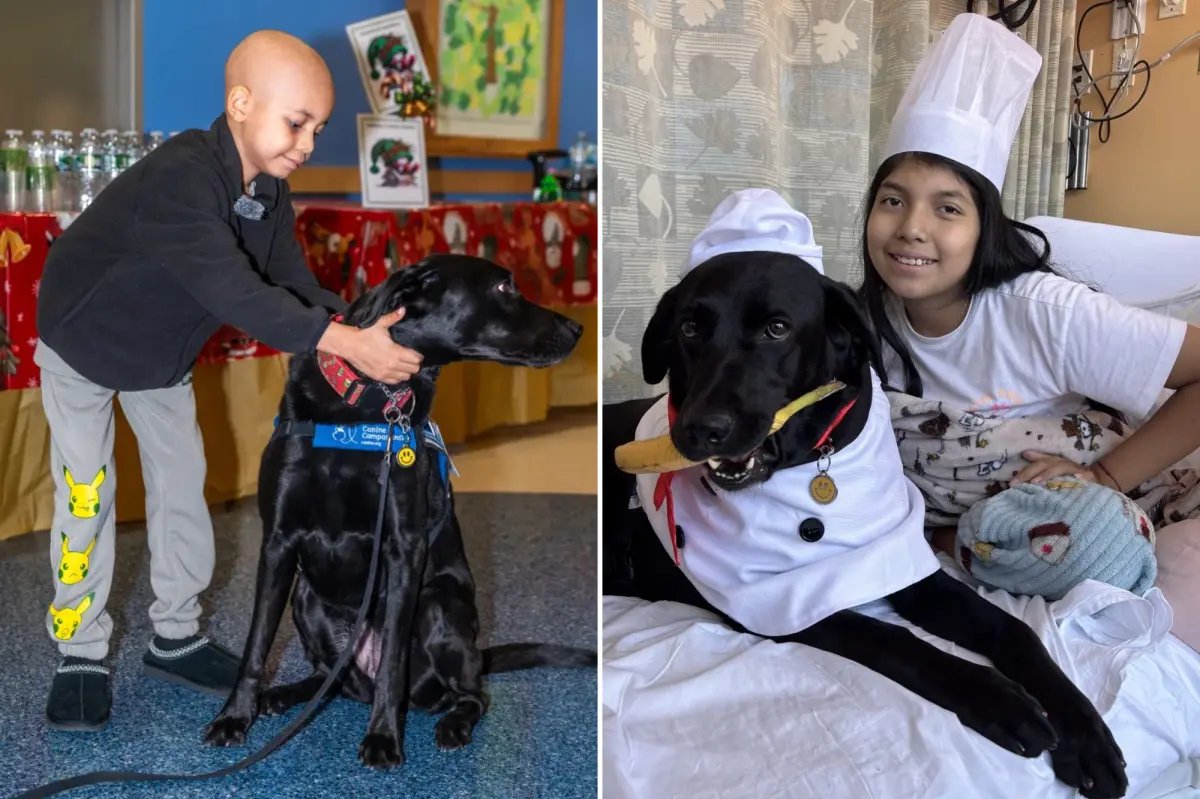


Polly may not wear a white coat, but she has excellent bedside manner.
The Labrador Retriever recently visited an 8-year-old cancer patient at Children’s Hospital at Montefiore Einstein (CHAM), who began experiencing tremors after doctors removed their breathing tube and reduced their sedative medications.
“When Polly was present in the bed with this patient, they calmed significantly and their tremors were noticeably less frequent,” Katy Dessick, Polly’s handler and a certified child life specialist, told The Post.
Polly’s presence helped ease what Dessick described as “an extremely difficult and emotional experience” for the child and their parents, who could see the difference the dog made.
The small moment illustrates how facility dogs — specially trained canines who work alongside health care professionals — can offer more than a welcome distraction from hospital life. Experts say they can help children manage anxiety, navigate frightening medical procedures and find the emotional breathing room to cope with serious illness.
Research backs them up. A 2023 study surveyed medial staff at a Japanese children’s hospital and found that 73% of respondents who had observed facility dogs reported that the animals “Always” or “Very often” helped them gain patients’ cooperation with treatment, procedures and end-of-life care.
At CHAM in the Bronx and Maimonides Medical Center in Brooklyn, those benefits take shape through Polly, 4, and Lev, a 7-year-old Labrador Retriever who works in Maimonides’ pediatric unit.
Helping kids open up
Serious illness can upend a child’s sense of normalcy. Hospital stays, invasive procedures and separation from family and friends can leave young patients frightened, anxious or unsure how to process what they’re experiencing.
Dr. Adit L. Tal, a pediatric hematologist-oncologist at CHAM, told The Post that children receiving care for blood disorders and cancer often struggle to express their feelings to doctors, nurses and other members of their medical teams.
But these dogs can help break through that barrier.
“A facility dog gives them the comfort to open up more,” said Tal. “In the presence of the dog, I see our patients become more calm and speak more freely to me and the medical team.”
The effect isn’t limited to younger children, either. Dessick sees teenagers open up around Polly, too, like during therapeutic art projects that help patients explore and express their emotions.
“One of Lev’s favorite things is getting treats from the patients. And the kids absolutely love being the ones who get to give them to him.”
Gabriel, Lev’s handler
Polly has worked with Dessick for nearly three years, visiting children across CHAM’s inpatient and outpatient pediatric specialities. The canine’s calm temperament helps Dessick navigate emotionally challenging situations, while her adaptability allows patients with different physical abilities to interact with her comfortably.
“Polly has a way of making each person she interacts with feel special,” said Dessick.
At Maimonides, Lev offers a similar source of comfort. His handler, Gabriel, has worked with him since the dog was only a few weeks old.
“Lev gives them a chance to focus on something completely different,” said Gabriel. “For a few minutes, it can be less about being a patient and more about petting a dog, giving him a treat, laughing and just being a kid again.”
Four-legged motivation
Facility dogs can also help children tackle the less cuddly side of medical care.
When patients grow reluctant to participate in physical therapy, get out of bed for a walk or follow a treatment plan, a dog’s company can give them a reason to try again, Tal explained. The animals can also help children manage fears surrounding medication, central line insertions and upcoming procedures.
The effect includes patients not requiring as much pain medication, she pointed out.
The dogs’ influence can extend beyond the children they visit. Caring for seriously ill patients and supporting distressed families takes an emotional toll on medical professionals, too. Facility dogs can offer staff a moment of calm amid the intensity of hospital work.
“Our jobs can be emotionally taxing, and having the dog there to keep calm has been imperative to our well being,” said Tal.
A 2022 study of pediatric hospital personnel found that staff associated facility dogs with improved workplace morale and well-being, as well as stronger rapport with patients and families.
At CHAM and Maimonides, facility dog programs operate with support from EnCourage Kids Foundation, a New York City-based nonprofit that works with hospitals to improve the pediatric experience through initiatives such as pet and music therapy.
A little less hospital, a little more childhood
For all the serious work Polly and Lev do, their hospital shifts also include plenty of play.
“One of Lev’s favorite things is getting treats from the patients,” said Gabriel. “And the kids absolutely love being the ones who get to give them to him.”
The dogs also welcome a good-old fashioned belly rub, stretching out on the floor to let their young patients and visitors return the affection.
They’re still very good boys and girls, after all.
For Gabriel, those unscripted moments capture the point of the visits.
“A child who may have been quiet, nervous or having a difficult day can suddenly be smiling, petting Lev and interacting with him,” said Gabriel.
“That is really what these visits are about, giving the children a little comfort, happiness and normalcy, and helping them forget about the hospital experience, even if it is only for a little while.”
