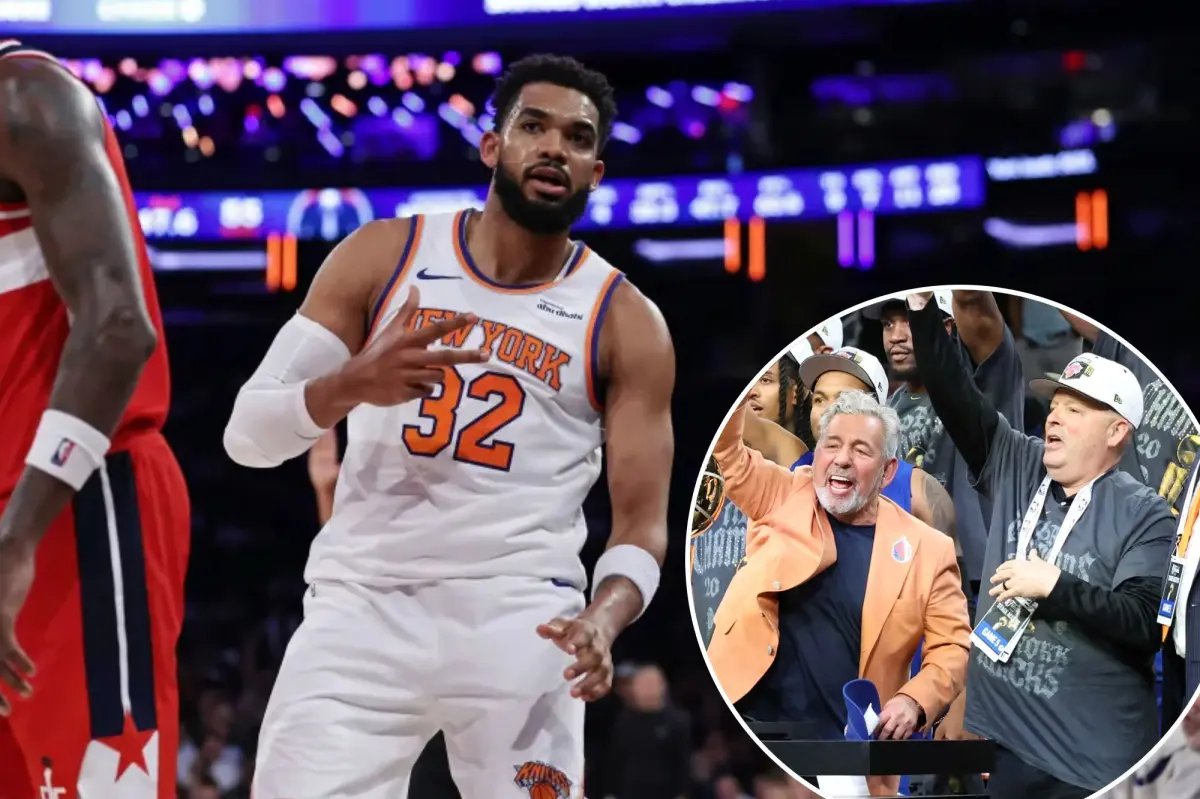

On Friday, the Knicks announced the tabling of all extension talks until after the season begins, putting aside the pressing issue of possible new deals for star players including Karl-Anthony Towns and Josh Hart.
One of the biggest obstacles in running back the same team that ended the Knicks’ 53-year championship drought over the summer is avoiding the severe penalties that come with exceeding the NBA’s salary cap.
The Knicks and the Cavaliers are the lone teams in the first apron, which alone carries some restrictions.

A team with a payroll above first apron, which in 2026-27 sits at just over $209 million, can only acquire players via sign-and-trade if they move them below the apron. It also must match salaries within 110% of the outgoing salary as compared to the usual 125%, and cannot sign any waived players during the regular season if that salary surpasses the midlevel exception.
The second apron sits at around $221.6 million for this season, and the limitations get more strict, impeding a team’s ability to make trades, sign big-name free agents and select the most desirable players in the first round of the draft.

Per the NBA’s CBA, should a team hit the second apron:
• It will not be permitted to combine the contracts of multiple outgoing players to match the salary of a player they’re trading for.
• It will lose their right to the midlevel exception that allows over-the-cap teams to still sign free agent players.
• Its future first-round draft pick will be frozen and thus cannot be traded, and there will be no cash considerations in their trades. That future frozen first-round selection will also automatically drop to the end of the first round, regardless of season performance, if the second apron is exceeded in two out of four seasons.
To put it simply, surpassing the second apron makes it extremely difficult for a team to build on its success and develop sustainable superteams, which certainly helps the league with parity, but doesn’t make players particularly happy as teams are often forced to make difficult decisions on high-value players.
That is exactly what the Knicks are facing right now. Knicks owner James Dolan said over the summer that he would not go past the second apron, even in an effort to bring back the championship-winning team in full.
Center Mitchell Robinson left for Boston on a three-year deal, and now several stars are eligible for extensions. This week, Bruce Brown, in Knicks camp on a tryout, expressed displeasure with how the second apron restrains teams from paying the mid-tier players.
“The new CBA is good for max guys, new free agents and rookie extension guys. The middle guys, it kind of sucks for us. There’s not a lot of people getting that full mid-level,” he said.
The NBA released a statement pushing back on similar claims, stating that “annual salaries have increased by nearly $1.3 billion resulting in pay increases of approximately 30% for all classes of players.”
The second apron helps owners by making it appealing to stay under the limit, but players are hurt when they find their teams can no longer pay them what they want or deserve, and might be forced to look elsewhere.
