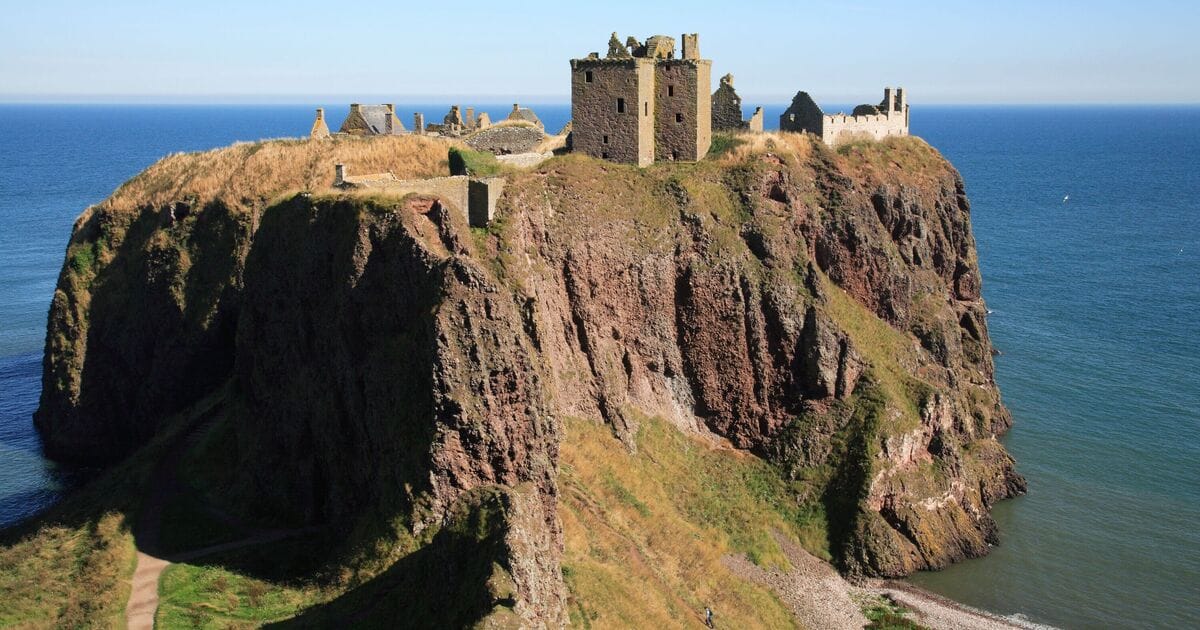

One clifftop castle in Scotland played a crucial role in the country’s long history until it began to fall into ruin in the 1720s after the owner became involved in the Jacobite rebellion.
Located near Stonehaven in Aberdeenshire is the clifftop fortress of Dunnottar Castle, which, although now in ruins, was once a magnificent and impregnable structure.
The ruins that can currently be seen and visit date back to 15th and 16th century, but the site was first fortified much earlier, with a chapel being founded on the site in the 5th century, supposedly by St Ninian.
It’s unclear exactly when this chapel was fortified, but two sieges were reported in the Annals of Ulster, taking place in 681 and 694, respectively.
During the reign of King William I of Scotland, Dunnottar became the centre of local administration for the Mearns region.
In this same time period, the castle appeared in the Arthurian romance Roman de Fergus, in which the hero must retrieve a magical shield from Dunnottar.
Dunnottar eventually fell into English hands until William Wallace captured it in 1297 during the Scottish War of Independence. He’s thought to have kept 4,000 prisoners in the castle before having them burned alive in the church.
Following the independence war, the castle began to fall into ruins until 1336, when King Edward III of English ordered the rebuilding and fortifying of the castle to be used as a resupply base for his Northern campaigns in support of Edward Balliol’s claim on the Scottish throne.
Around 1359, the castle fell into the hands of William Keith, following his marriage to Margaret Fraser, the niece of Robert the Bruce.
He then completed construction of the tower house at Dunnottar but was excommunicated by the Pope for building on consecrated ground without the church’s permission.
This excommunication was later lifted 1395, and the Keith family continued to reside at Dunnottar until the 1700s.
During these years, the castle welcomed numerous Royal visitors, including Mary, Queen of Scots, and James VI of Scotland and I of England.
During the English Civil War, the Keith family supported the Covenanters, but later became Royalists and following the execution of King Charles I they were among the Scots who swore loyalty to his son Charles II.
Charles II even visited Dunnottar in July 1650, and his presence in Scotland prompted Oliver Cromwell to launch an invasion into the country. During this time Scottish Crown Jewels known as the Honours of Scotland, were kept at the Castle for safekeeping.
In 1715, George Keith, 10th Earl Marischal, played a key role in the Jacobite rebellion, which aimed to overthrow King George I and place James Edward Stuart, known to history as the Old Pretender, on the British throne.
Following Keith’s family’s role in this plot, they were forced to forfeit their lands and titles, and the castle began to fall into ruin. And although there have been numerous conservation attempts, these came slightly too late to completely save Dunnottar.
