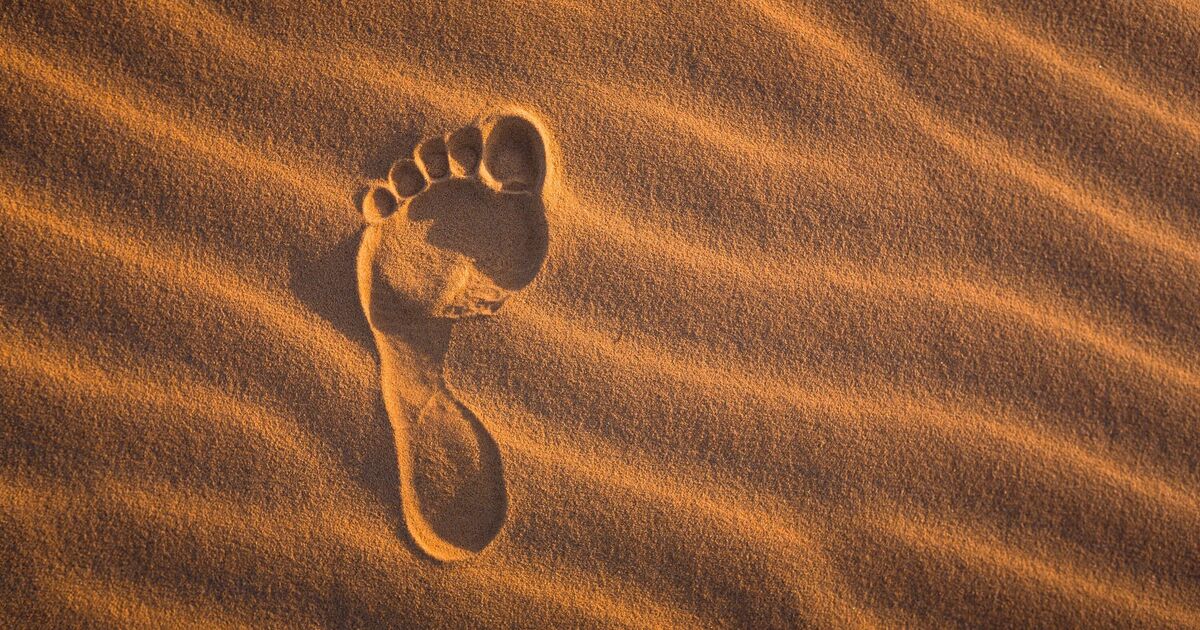

Archaeologists uncovered the oldest-ever human footprint in the Middle East. The footprints, carefully preserved in a prehistoric mudhole, indicate human migration before the Ice Age.
Seven footprints believed to be about 115,000 years old have been found amid various prehistoric animal prints. This special lakebed in northern Saudi Arabia has been home to many such fossils and ancient artefacts since scientists found it in 2017 in the Nefud Desert. Named “the trace” in Arabic, this lakebed was seemingly a high-traffic area over 100,000 years ago. The lake that forms Alathar today was presumably the area where large animals gathered to rest or drink as they migrated due to changing weather and climate conditions. Footprints left behind in ancient mud by populations often help trace their history, the scientists found.
The scientists said in their paper: “An experimental study of modern human footprints in mud flats found that fine details were lost within two days and prints were rendered unrecognisable within four, and similar observations have been made for other non-hominin mammal tracks.”
In the Burgess Shale event, the oldest organisms were preserved intact because they fell into a mudslide, dying instantly. An armoured dinosaur was found in great shape as it was discovered on the cold ocean floor, covered in mud.
While Homo sapiens were not the only upright primates in the era, according to mounting evidence, the prints belonged to humans, the scientists said.
The paper read: “Seven hominin footprints were confidently identified, and given the fossil and archaeological evidence for the spread of H. sapiens into the Levant and Arabia during [the era 130,000 to 80,000 years ago] and absence of Homo neanderthalensis from the Levant at that time, we argue that H. sapiens was responsible for the tracks at Alathar.”
It added: “In addition, the size of the Alathar footprints is more consistent with those of early H. sapiens than H. neanderthalensis.”
Scientists have not found other tool marks or knives on animal bones in the area that indicate hunting. This indicates that humans might have been there to drink water.
“The lack of archaeological evidence suggests that the Alathar Lake was only briefly visited by people,” they said. “These findings indicate that transient lakeshore use by humans during a dry period of the last interglacial was likely primarily tied to the need for potable water.”
These possible humans could have been the last ones to migrate through a temperate climate before being decimated by the Ice Age, which is likely why their tracks were not followed by a different group.
